


There are certain words in investing that carry a weight heavier than their definitions suggest. “Drawdown” is one of them. The first time I encountered it, years ago, I felt an instinctive resistance—an urge to turn away from what it represented. Loss is uncomfortable to look at. Decline even more so. And maximum drawdown, that measure of how far a stock falls from its peak before rising again, felt like staring directly into a company’s most vulnerable moment.
But vulnerability has a strange way of revealing truth.
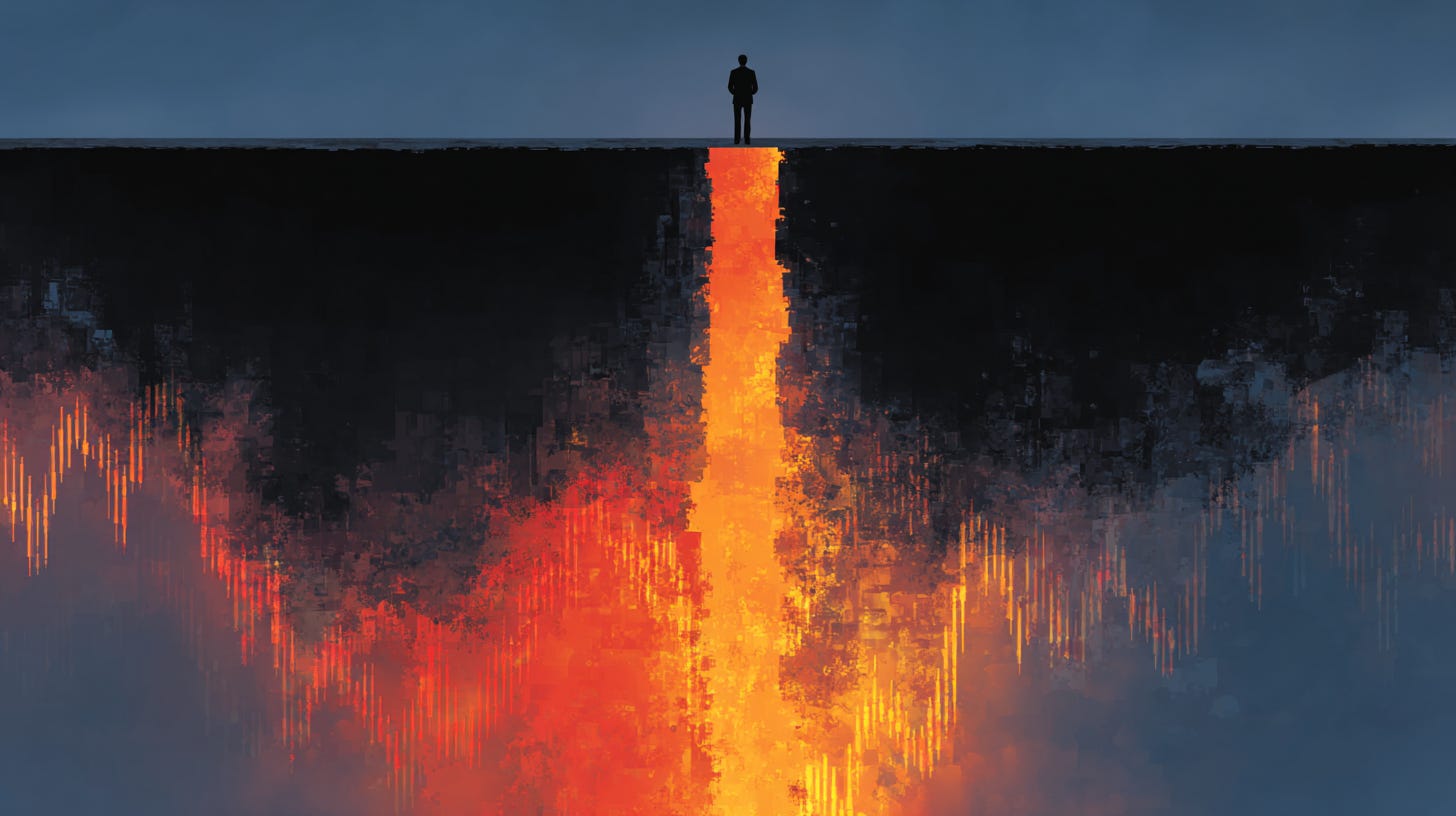
When my son asked me recently what drawdown really meant, I found myself remembering all the times I, too, tried to avoid looking at the hard parts of the market. I wanted growth, acceleration, upward movement. I didn’t want to confront the valleys. Yet it’s the valleys that teach us the most—about companies, about cycles, and about ourselves.
Maximum drawdown is the distance between who a company once was and who it becomes when tested. It shows how deep the cuts go before healing begins. In that space between peak and recovery, something essential is revealed: the company’s temperament under pressure.
I tried to explain it to him the way I’ve come to feel it: two companies can rise the same amount over five years, but one may crash violently along the way, falling into dark holes from which it barely climbs out, while the other moves with steadier, calmer steps. Their returns might match, but their journeys do not. And for a portfolio—especially one built for peace of mind—the journey matters.
Drawdown tells us about volatility not as an abstract concept, but as a lived experience. It shows how much emotional weight an investor must carry if they choose to walk with that stock. When a company falls 60% from its highs, even if it later recovers, those months or years in the depths can test our resolve. They ask us to hold our breath longer than most of us are built to hold it.
Over time, I began to see that low drawdown is not merely a sign of stability—it is a sign of discipline, both in the business and in the market’s relationship to it. These are the companies that bend but do not break, the ones that move with a steadiness that feels almost like trustworthiness. Not exciting, perhaps. Not headline-worthy. But dependable.
And in investing, dependability quietly outperforms drama.
I’ve watched investors get seduced by high flyers that rocket upward only to collapse under the weight of their own momentum. I’ve watched others cling to companies that deliver spectacular gains but carry the emotional toll of unpredictable freefalls. And I’ve watched portfolios crumble not because the stocks were bad, but because the volatility was unbearable.
So when I speak of maximum drawdown, I’m really speaking about emotional sustainability. The kind of investing that allows a person to live their life without checking the market every hour. The kind that respects the human heart as much as the mathematical return.
I told my son that every company has a story of loss hidden behind the story of growth. And we must learn to read both.
Maximum drawdown is the chapter where the mask slips, where the company’s true nature appears. Does it collapse and linger in the depths? Or does it gather itself slowly, deliberately, and rise beyond what it was before?
That is why drawdown matters.
Because in those darkest stretches, we discover the resilience that no chart can fully capture but every long-term investor depends upon.
In the end, we don’t invest only in potential—we invest in the strength to overcome the inevitable declines along the way. And maximum drawdown, uncomfortable as it is, points us toward the companies that know how to climb back up.